

 by
by 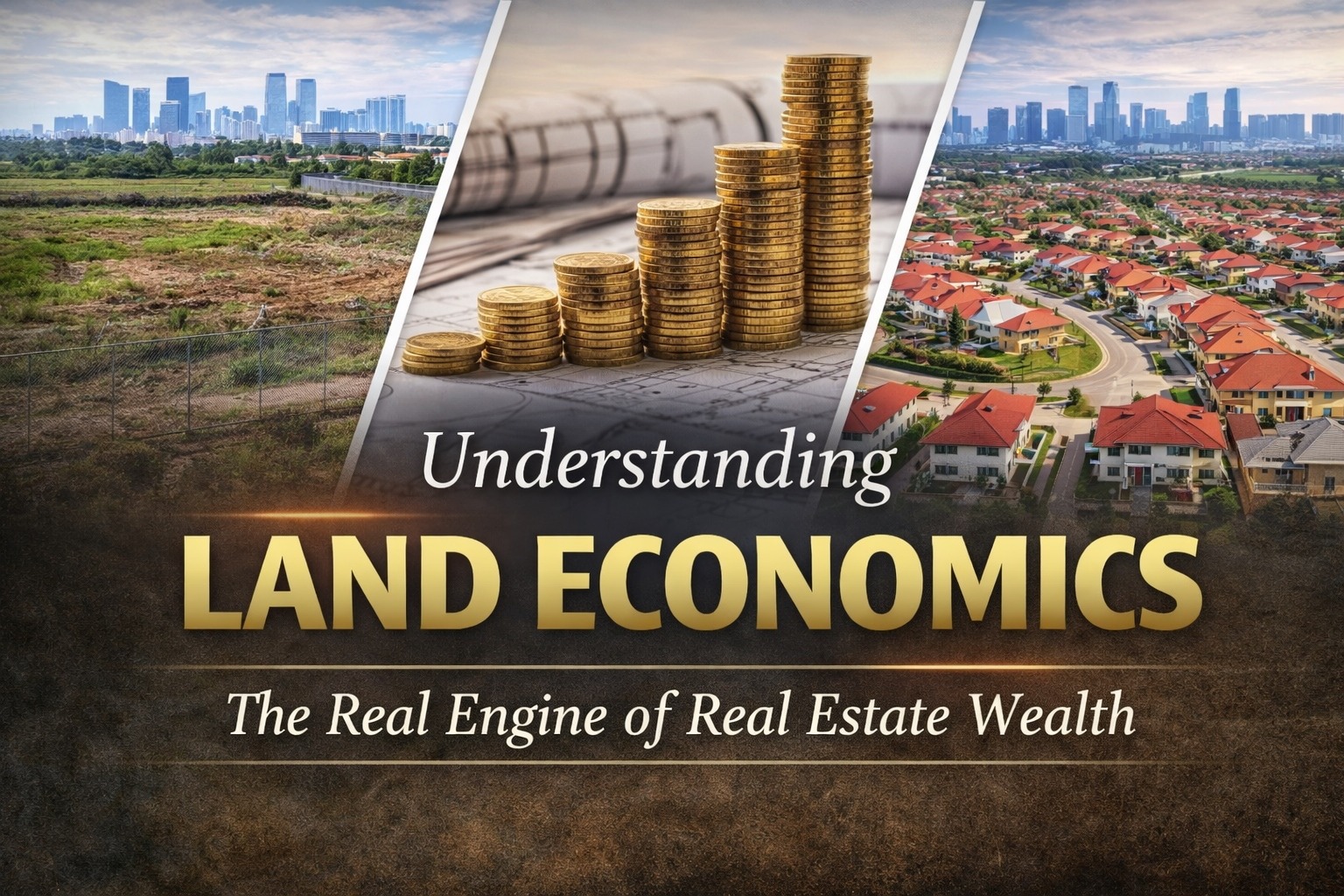
Understanding Land Economics: The Real Engine of Real Estate Wealth
Buildings catch the eye.
Land builds the wealth.
Most people experience real estate through what they can see—houses, apartments, offices, shopping centres. Walls, finishes, design, and amenities dominate conversations. Yet beneath every successful property investment lies a quieter force, rarely discussed but relentlessly powerful: land economics.
Land is not simply the surface on which buildings stand. It is a finite resource, shaped by policy, infrastructure, human movement, and time. While buildings age, depreciate, and eventually become obsolete, land often does the opposite. It appreciates, transforms, and redefines its own potential.
To understand real estate—truly understand it—is to understand land economics. Everything else is secondary.
Land Before Buildings: A Fundamental Distinction
One of the most critical distinctions in property economics is the difference between land value and improvement value.
Buildings are manufactured assets. They:
-
Have a finite lifespan
-
Require maintenance
-
Depreciate physically and functionally
-
Are replaceable
Land, on the other hand:
-
Is finite
-
Cannot be relocated
-
Does not depreciate physically
-
Gains value primarily from external forces
This is why, over long periods, property wealth tends to accumulate not because of buildings, but despite them. The structure provides utility and income; the land captures economic growth.
Understanding this distinction is the first step toward understanding why land economics sits at the core of real estate wealth creation.
What Is Land Economics?
Land economics examines how land is allocated, valued, regulated, and utilised within an economy. It is concerned with:
-
Scarcity
-
Location
-
Accessibility
-
Regulation and zoning
-
Infrastructure
-
Demand concentration
Unlike most goods, land supply is fixed. Cities cannot manufacture more land in prime locations. As populations grow and economies expand, competition for well-located land intensifies. Prices rise not because land becomes “better,” but because more people want access to it.
Land economics explains why:
-
Two identical houses in different locations can have vastly different values
-
Infrastructure projects reprice entire regions
-
Policy decisions create or destroy billions in land value
-
Timing often matters more than design
The Historical Roots of Land Value
Long before modern cities, land determined power and wealth.
Agrarian societies measured prosperity by land ownership. Control over fertile land meant food security, influence, and political authority. As societies industrialised, land near ports, railways, and factories gained value. In the modern era, land near economic nodes—CBDs, transport corridors, innovation hubs—commands the highest premiums.
Each economic phase reshapes land values:
-
Agricultural economies favour fertile and accessible land
-
Industrial economies favour transport-connected land
-
Service economies favour proximity, connectivity, and density
-
Knowledge economies favour agglomeration and talent clusters
Land economics evolves alongside the economy, continuously reallocating value based on how people live and work.
Scarcity: The Non-Negotiable Driver
Scarcity is the most fundamental principle in land economics.
While buildings can be demolished and rebuilt, land in a specific location cannot be replicated. This creates a hierarchy of value based on:
-
Proximity to economic activity
-
Access to infrastructure
-
Desirability and status
-
Regulatory allowances
Urban land scarcity is rarely natural. It is often manufactured through planning controls, zoning restrictions, and infrastructure decisions. These constraints, intentional or otherwise, create value by limiting supply.
This is why land prices rise even when construction costs stabilise. Demand grows, supply remains fixed, and competition intensifies.
Location: More Than a Catchphrase
“Location, location, location” is often repeated, rarely explained.
From a land economics perspective, location is not a vague concept—it is measurable. It includes:
-
Travel time to employment centres
-
Access to transport infrastructure
-
Availability of utilities
-
Social and economic clustering
-
Perceived status and safety
Land closer to opportunity commands higher value because it reduces friction. Time, cost, and effort decrease. Productivity increases. Over time, markets capitalise these advantages into land prices.
Importantly, location is dynamic. What was peripheral yesterday can become prime tomorrow once infrastructure and policy align.
Infrastructure as a Land Value Multiplier
Infrastructure does not simply serve land—it redefines it.
Roads, rail, ports, airports, utilities, and digital connectivity compress space. They reduce travel time and expand economic reach. When infrastructure arrives, land values adjust rapidly, often before buildings change.
This is why:
-
Highway interchanges attract commercial development
-
Rail stations trigger densification
-
Bypasses reprice previously overlooked areas
-
Utility extensions unlock dormant land
In land economics, infrastructure is not a cost—it is an investment that creates value, often captured by landowners rather than the public sector.
Zoning and Planning: The Invisible Hand of Value
Few forces influence land economics more profoundly than planning regulation.
Zoning determines:
-
What can be built
-
How dense development can be
-
Whether land is residential, commercial, or mixed-use
A change in zoning can multiply land value overnight without a single brick being laid. Conversely, restrictive zoning can suppress land value even in prime locations.
This is why experienced investors study planning frameworks as closely as market prices. Land value is not just about demand—it is about permitted use.
Highest and Best Use: Where Economics Becomes Strategy
At the heart of land economics lies the principle of Highest and Best Use (HBU).
Highest and Best Use refers to the use of land that is:
-
Legally permissible
-
Physically possible
-
Financially feasible
-
Maximally productive
Land is rarely valued based on its current use. It is valued based on its potential.
A single-storey house on a plot zoned for high-density apartments is not valued as a house—it is valued as a development site. The existing structure may even be a liability.
Understanding HBU transforms how land is perceived:
-
Underutilised land represents hidden value
-
Obsolete improvements can mask economic potential
-
Time becomes a strategic asset
HBU is where land economics moves from theory into decision-making.
Land vs Building Cycles
Buildings follow construction and depreciation cycles. Land follows economic cycles.
During downturns:
-
Building values may stagnate or decline
-
Land values often hold or recover faster
During growth phases:
-
Buildings generate income
-
Land captures appreciation
Over long periods, land tends to outperform buildings as a store of value. This is why institutional investors and developers focus on land acquisition strategy long before design decisions are made.
Urbanisation and the Concentration of Value
Urbanisation is a land economics phenomenon.
As people cluster around opportunity, land values concentrate around:
-
Employment nodes
-
Transport hubs
-
Lifestyle centres
This concentration creates gradients of value—high at the core, tapering outward. However, infrastructure can flatten or reshape these gradients, creating new centres and redistributing value.
Understanding urban growth patterns is essential for anticipating land appreciation.
Speculation vs Strategic Land Holding
Not all land investment is speculative.
Speculation relies on price appreciation without a clear understanding of demand, policy, or infrastructure. Strategic land holding, by contrast, is grounded in land economics:
-
Anticipating zoning changes
-
Tracking infrastructure plans
-
Understanding demographic trends
-
Identifying future highest and best use
The difference between the two is knowledge, not patience.
Why Land Economics Explains Wealth Creation Better Than Property Marketing
Marketing focuses on finishes. Land economics focuses on fundamentals.
A beautifully finished building on poorly located land will struggle to retain value. A modest structure on strategic land often outperforms expectations.
This is why seasoned investors often say:
“You make money when you buy land, not when you build.”
The Kenyan and Emerging Market Context
In emerging markets, land economics plays an even more decisive role due to:
-
Rapid urbanisation
-
Infrastructure-led growth
-
Evolving planning frameworks
-
Informal to formal land transitions
Peri-urban land often captures the highest appreciation as cities expand outward. Infrastructure corridors become value corridors. Land ownership, title security, and zoning clarity become critical determinants of wealth creation.
Understanding land economics in such markets is not optional—it is essential.
Risk in Land Economics
Land is powerful, but not risk-free.
Key risks include:
-
Policy reversals
-
Infrastructure delays
-
Over-zoning without demand
-
Title and tenure issues
Sound land economics analysis balances opportunity with governance, timing, and legal certainty.
The Long View: Land as a Generational Asset
Unlike buildings, land often outlives its first owner.
Families pass down land across generations. Cities grow around it. Uses change. Value compounds quietly.
Those who understand land economics think in decades, not quarters. They invest in location, access, and policy alignment, knowing that time does much of the work.
Final Reflection: Seeing What Others Ignore
Most people buy buildings.
Few truly buy land.
Land economics teaches us to look beyond what exists today and focus on what is becoming possible tomorrow. It reveals why value shifts, why cities grow the way they do, and why the most enduring real estate wealth is created long before construction begins.
In the end, buildings serve people.
Land serves the economy.
And those who understand that distinction rarely build wealth by accident.

Our Fact Checking Process
We prioritize accuracy and integrity in our content. Here's how we maintain high standards:
- Expert Review: All articles are reviewed by subject matter experts.
- Source Validation: Information is backed by credible, up-to-date sources.
- Transparency: We clearly cite references and disclose potential conflicts.
Your trust is important. Learn more about our Fact Checking process and editorial policy.
Our Review Board
Our content is carefully reviewed by experienced professionals to ensure accuracy and relevance.
- Qualified Experts: Each article is assessed by specialists with field-specific knowledge.
- Up-to-date Insights: We incorporate the latest research, trends, and standards.
- Commitment to Quality: Reviewers ensure clarity, correctness, and completeness.
Look for the expert-reviewed label to read content you can trust.



Join The Discussion