

 by
by 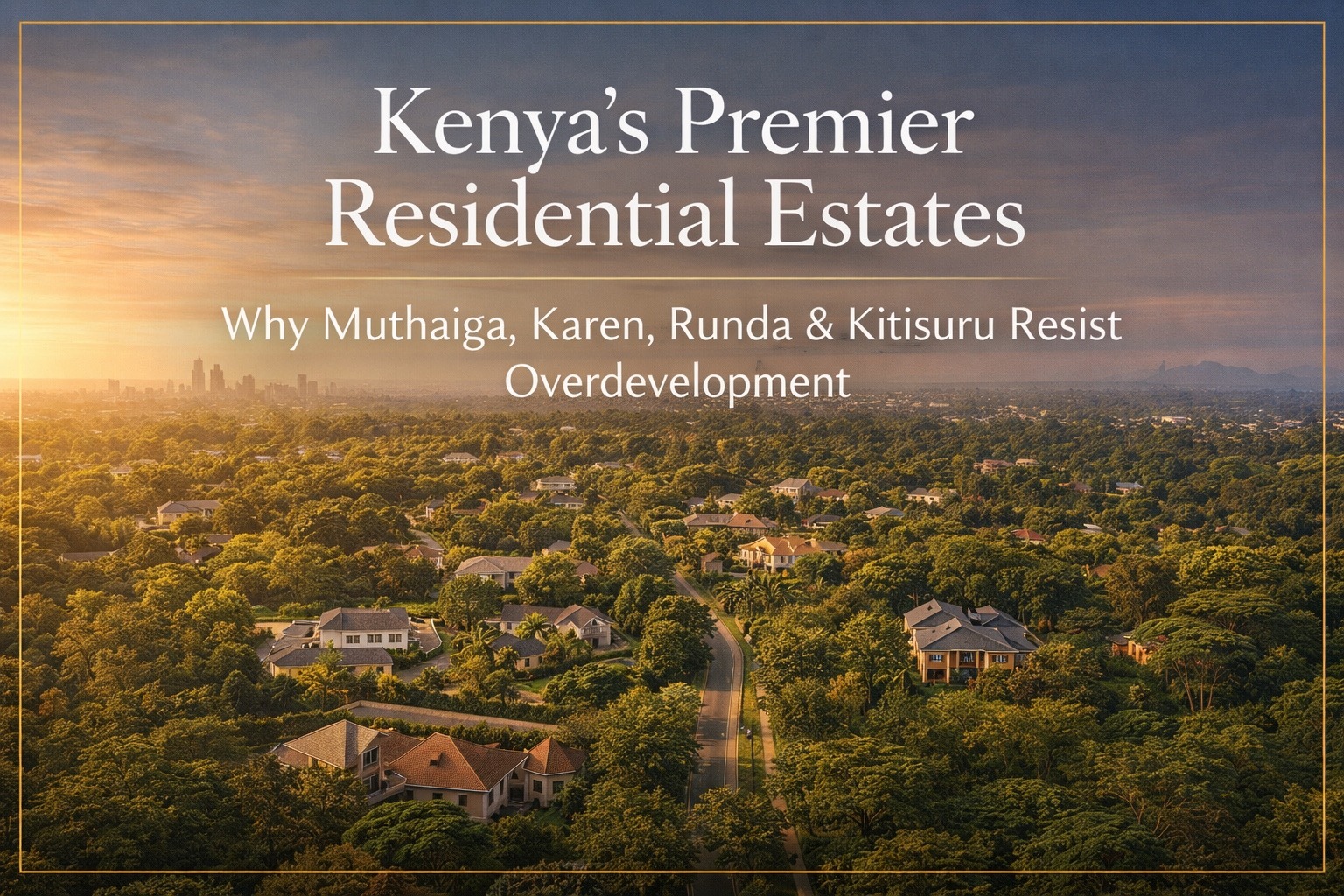
Kenya’s Premier Residential Estates: How Low-Density Planning Protects Your Property Value
Discover why Muthaiga, Runda, Karen, and Kitisuru remain Kenya’s most resilient blue-chip neighbourhoods—and how their deliberate resistance to overdevelopment safeguards wealth, privacy, and long-term returns.
—
What Makes a Neighbourhood a Premier Estate?
In Kenya’s real estate landscape, a handful of names command lasting respect: Muthaiga, Runda, Karen, and Kitisuru. These are not merely affluent suburbs; they are Kenya premier residential estates, carefully shaped over decades through disciplined planning.
While much of Nairobi has experienced rapid densification, speculative construction, and shifting identities, these four estates have largely resisted overdevelopment. That resistance is not stagnation—it’s strategy. Understanding why these neighbourhoods remain low-density, and why that matters, offers valuable insight into how premium property behaves, how wealth is protected through land, and why certain addresses stay desirable regardless of market cycles.
The defining traits of a top-tier estate are:
– Generous plot sizes
– Strict zoning controls
– Mature infrastructure
– A resident base that actively safeguards planning discipline
These areas were never designed for maximum yield per acre. They were designed for long-term livability, privacy, and environmental balance—qualities that have since become powerful economic advantages. As land elsewhere densifies, the scarcity of low-density neighbourhoods increases, reinforcing both capital value and demand stability.
—
The Four Pillars of Nairobi’s Blue-Chip Property Market
Muthaiga: Scarcity and Legacy
Muthaiga holds a unique position in Nairobi’s residential hierarchy. Established during the colonial era, it remains one of the city’s most exclusive and tightly controlled neighbourhoods. Large land parcels, mature tree canopies, and restrained redevelopment define the area. Subdivision is minimal, and multi-dwelling developments are largely absent.
What truly protects Muthaiga is scarcity reinforced by social and planning resistance. Property ownership is often generational, and transactions are infrequent. When redevelopment occurs, it is typically one high-end home replacing another—not an intensification of density. This preservation of character has kept Muthaiga’s land values among the highest in the country, supported not by hype but by permanence.
Runda: Governance-Driven Control
Runda represents a more structured approach to exclusivity. Developed with security and order in mind, the estate benefits from formal planning frameworks and an active homeowners’ association. Plot sizes are generous, road networks intentionally designed, and access is controlled.
The presence of diplomatic missions and expatriate residents has further reinforced standards. Security considerations, infrastructure quality, and community oversight act as natural barriers against uncontrolled densification. Runda’s ability to resist overdevelopment is rooted in governance: rules are enforced, deviations are challenged, and residents’ collective interest aligns with preserving long-term value.
Karen: Zoning, Space, and Environmental Protection
Karen is defined by space. Historically agricultural, the area evolved into a residential enclave where large plots and natural landscapes became central to its identity. Strict zoning regulations, minimum plot sizes, and proximity to protected forests and conservation areas have limited large-scale densification.
While commercial development has expanded along major roads, interior residential zones remain largely intact. Karen’s resistance to overdevelopment is reinforced by its geography. Rolling terrain, mature vegetation, and environmental considerations make high-density construction both impractical and undesirable. Buyers here are not simply purchasing homes; they are acquiring lifestyle, air quality, and visual openness—assets that cannot be replicated once lost.
Kitisuru: Quiet Discipline in a Strategic Location
Kitisuru’s strength lies in discretion. Situated near major commercial hubs yet shielded from their intensity, it has quietly maintained its residential integrity. Although some subdivision and cluster developments have occurred, overall density remains significantly lower than surrounding areas. Community vigilance and planning controls have limited vertical and high-density projects.
This balance between accessibility and restraint has allowed Kitisuru to appreciate steadily without losing its identity.
—
Why Overdevelopment Erodes Value in Prime Estates
Overdevelopment often promises short-term gains but carries long-term consequences. Increased density strains infrastructure, reduces privacy, and alters neighbourhood character. In premium residential markets, value is not driven by volume but by scarcity, predictability, and quality of environment.
When estates densify indiscriminately, they lose the very attributes that attracted high-net-worth buyers in the first place. Traffic congestion, noise, pressure on utilities, and declining visual appeal gradually erode desirability—translating into slower price growth and increased volatility.
Kenya’s premier residential estates have avoided this trap by prioritizing restraint over rapid monetization.
—
How Low Density Protects Long-Term Property Value
Low-density estates benefit from several reinforcing dynamics:
– Limited supply keeps demand competitive
– Larger plots provide flexibility for renovation without altering neighbourhood scale
– Infrastructure performs better under lower pressure, reducing maintenance costs
– Security is easier to manage, and community standards are easier to uphold
– Lifestyle quality is preserved—privacy, greenery, and spatial comfort are increasingly rare urban commodities
Their scarcity enhances both emotional and financial value.
Land as the Primary Asset
In these estates, land—not buildings—is the core store of wealth. Homes can be rebuilt, extended, or modernized. Land cannot. Large plots offer optionality: a buyer can live in an older house, renovate incrementally, or redevelop entirely without changing the neighbourhood’s character.
Overdevelopment erodes this advantage. When plots are aggressively subdivided, optionality disappears, and future buyers inherit constraints rather than opportunities.
—
Buyer Behaviour and Market Resilience
Buyers in Muthaiga, Runda, Karen, and Kitisuru typically exhibit long holding periods. Properties are acquired with generational or long-term intent rather than short-term resale. This buyer profile stabilizes prices during market downturns.
There is less forced selling, fewer speculative listings, and greater confidence in intrinsic value. As a result, these estates often experience:
– Fewer distressed sales
– Lower price volatility
– Reduced inventory during slowdowns
– Faster recovery when demand returns
Because most owners are not overleveraged, forced selling is rare—protecting price floors and reinforcing buyer confidence.
—
The Role of Planning History and Community Oversight
One of the most overlooked reasons these estates resist overdevelopment lies in how they were originally planned. Muthaiga, Karen, Runda, and Kitisuru were not conceived as speculative housing zones. Road reserves were generous, drainage corridors clearly defined, and plot setbacks enforced not to maximize yield but to create breathing room.
This foundational planning has allowed these estates to absorb population growth around them without collapsing internally. In contrast, many newer neighbourhoods were designed with immediate return in mind, resulting in narrow roads, overstretched utilities, and zoning compromises that later become irreversible.
Community Influence Shapes Planning Outcomes
Residents in these estates are not passive observers of development trends—they are active participants. Formal residents’ associations, informal neighbourhood consensus, and long-standing social capital play a significant role in how development applications are received. Proposals that threaten density, privacy, or infrastructure capacity often face resistance.
This collective stewardship creates predictability. Buyers know what to expect, developers understand the boundaries, and authorities are under pressure to uphold zoning intentions.
—
Comparative Density: Why Fewer Units Mean Higher Confidence
Density is often framed as efficiency, but in luxury residential markets, it can become a liability. Low-density estates provide:
– Reduced traffic and noise
– Better security management
– Lower strain on utilities
– Greater visual and acoustic privacy
As Nairobi densifies elsewhere, these qualities become more valuable, not less. The psychological comfort of space increasingly translates into financial premium.
—
Environmental Capital: Trees, Air, and Silence as Value Drivers
Environmental quality is increasingly recognized as a form of capital. Mature trees, biodiversity, and low noise levels are not aesthetic luxuries—they are assets. Karen’s proximity to forests, Muthaiga’s canopy, Runda’s landscaped avenues, and Kitisuru’s green buffers all contribute to liveability that cannot be recreated once lost.
As climate awareness grows, estates that offer natural cooling, cleaner air, and visual relief will continue to outperform.
—
What Buyers Should Look for in Blue-Chip Estates
For prospective buyers, understanding why these estates resist overdevelopment provides a framework for decision-making. Key considerations include:
– Plot size and zoning history
– Neighbourhood density trends
– Presence of active residents’ associations
– Infrastructure capacity
– Recent planning approvals in the area
These indicators reveal whether an estate is likely to preserve its character—or drift toward congestion.
—
The Future Outlook: Evolution Without Dilution
Change is inevitable, even in Kenya’s most exclusive neighbourhoods. Older homes will be replaced, sustainability features will become standard, and architectural styles will evolve. However, the core principles protecting these estates—zoning discipline, community oversight, land scarcity, and environmental consideration—are likely to remain intact.
Rather than densifying, these estates will modernize quietly, preserving their essence while adapting to contemporary living standards.
—
The Bottom Line: Resistance Is the Real Luxury
Muthaiga, Runda, Karen, and Kitisuru demonstrate that the most valuable form of growth is controlled growth. Their resistance to overdevelopment is not opposition to progress but a commitment to long-term value.
In a market often




Join The Discussion