

 by
by 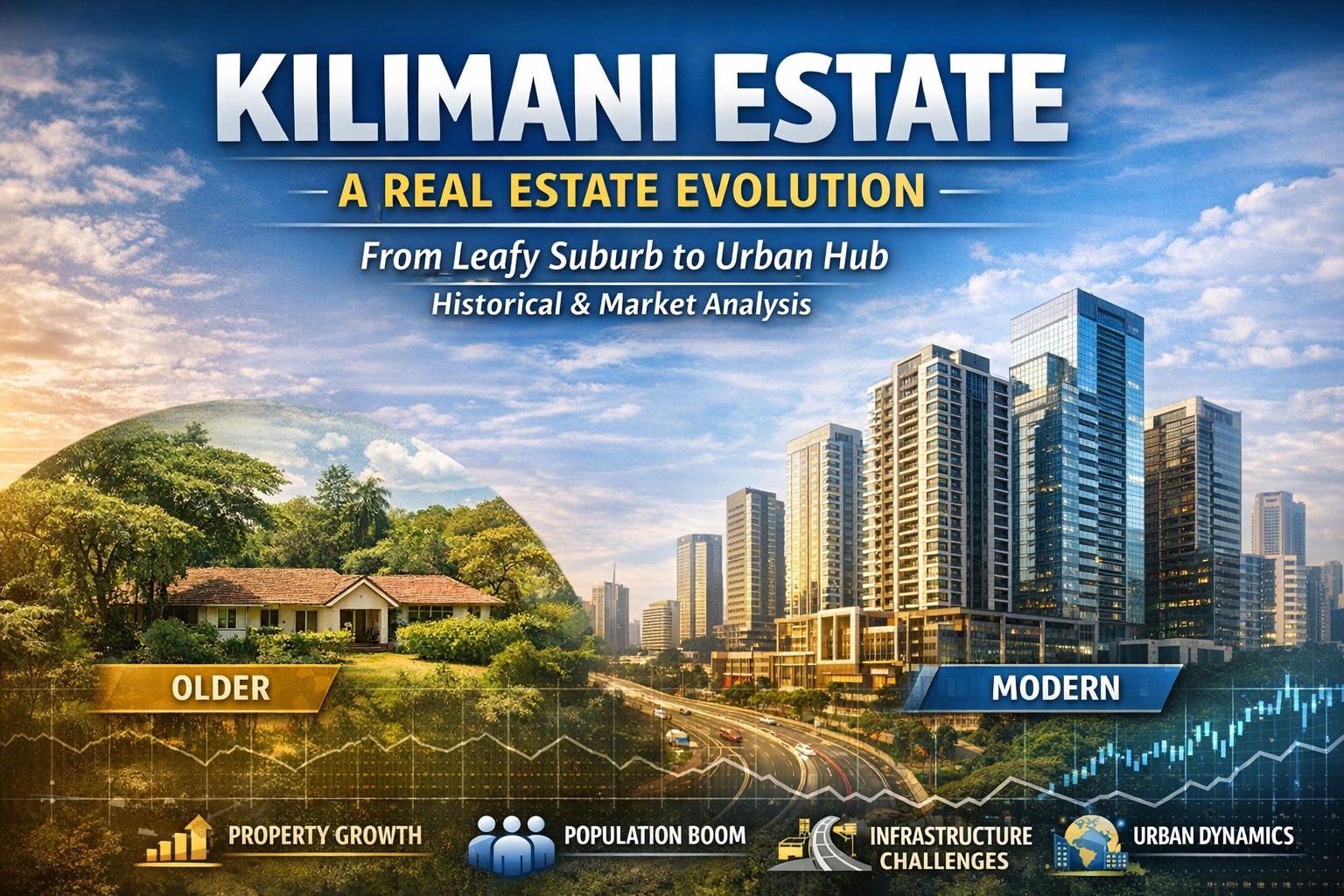
Kilimani Estate Nairobi: Historical Development and Real Estate Analysis
From colonial-era bungalows to a high-density mixed-use hub, this Kilimani property market analysis traces the estate’s remarkable transformation and the infrastructure strains that have accompanied its rapid densification. Discover how location, shifting policy, and market forces have reshaped this Nairobi neighbourhood into a compelling case study for investors and urban planners alike.
Kilimani Estate stands as one of Nairobi’s most prominent urban neighbourhoods—and a critical case study in understanding land use change, urban densification, infrastructure stress, and real estate market evolution in Kenya. Once a low-density, leafy residential suburb characterised by bungalows and maisonettes, Kilimani has transformed into a high-density, mixed-use urban zone dominated by apartment blocks, offices, hospitality developments, and lifestyle amenities.
This analysis examines Kilimani’s historical development, demographic change, infrastructural expansion and limitations, land use transformation, real estate market performance, and emerging planning challenges—situating the estate within Nairobi’s broader urban growth trajectory.
A Brief History of Kilimani’s Development
Colonial Origins and Early Post-Independence Era
Kilimani’s roots lie in Nairobi’s colonial spatial planning framework, which segregated residential areas based on race and income. During the colonial period and early years following independence, Kilimani was designated as a low-density residential area primarily for middle- to high-income households.
Large plots accommodated single-family bungalows and maisonettes, often surrounded by mature gardens and tree cover. The estate’s appeal lay in its strategic location—approximately four kilometres south-west of Nairobi’s Central Business District (CBD)—offering easy access to the city while maintaining a distinctly suburban character.
Early infrastructure, including road layouts, sewer systems, and water supply, was designed to serve low population densities. These planning assumptions would later prove woefully inadequate for the development intensity that followed.
The Quiet Suburban Character
In its early decades, Kilimani exemplified Nairobi’s planned residential suburbs: quiet streets, limited commercial activity, and a relatively homogeneous population profile. Land ownership was largely private, tenure security was strong, and the environment supported stable, long-term residential occupation.
The Turn Towards Densification
Economic Liberalisation and Urban Pressure
From the 1990s onwards, Nairobi experienced rapid population growth driven by rural–urban migration, economic restructuring, and regional integration. Demand for housing near employment centres increased significantly, and Kilimani—with its prime location and established infrastructure—emerged as a top candidate for redevelopment.
Economic liberalisation policies encouraged landowners to reconsider the economic potential of their plots. Single-family homes began giving way to walk-up apartments and small commercial developments, marking the onset of Kilimani’s densification.
Zoning Shifts and Planning Policy
Kilimani falls under Nairobi’s residential planning zones originally intended for low to medium density development. However, zoning regulations were either revised or inconsistently enforced over time. Developers capitalised on ambiguities and approvals that permitted increased plot ratios and building heights, accelerating the shift from horizontal to vertical development.
Demographic Change and Population Growth
A Rapidly Growing Population
Kilimani’s densification has brought substantial population growth. While precise figures vary, the estate’s population is estimated to have increased several-fold over the past two decades. This growth stems less from natural increase and more from inward migration of tenants drawn by proximity to employment nodes, social amenities, and transport links.
A Diversifying Demographic Profile
Kilimani’s demographic composition has diversified considerably. Today, the estate hosts:
– Young professionals seeking proximity to Upper Hill and CBD offices
– Expatriates attracted by serviced apartments and lifestyle amenities
– Students attending nearby institutions
– Small households and investors
Household sizes have generally decreased, while tenancy rates have risen relative to owner-occupation. This shift has influenced housing typologies, with growing demand for one- and two-bedroom apartments, serviced units, and short-term accommodation.
Infrastructure Development and Capacity Constraints
Road Network and Transport Challenges
Kilimani’s original road network was designed for low traffic volumes—a reality far removed from today’s conditions. As development intensified, traffic congestion became persistent. Key access roads experience peak-hour gridlock, exacerbated by increased car ownership and limited public transport integration.
Road upgrades have occurred sporadically and reactively rather than as part of a comprehensive transport plan. Non-motorised transport infrastructure, including pedestrian walkways and cycling lanes, remains inadequate.
Water Supply and Sewerage Strain
Water and sewer systems in Kilimani were engineered for low-density residential use. Rapid densification has placed significant strain on these networks, resulting in intermittent water shortages and frequent sewer overflows in some sections of the estate. Developers have increasingly relied on boreholes and on-site waste management solutions, raising concerns about groundwater sustainability and environmental health.
Electricity and Digital Connectivity
Electricity supply has generally kept pace with development, supported by grid expansion and private investment in backup power solutions. Digital infrastructure, particularly fibre-optic connectivity, has expanded rapidly—enhancing Kilimani’s attractiveness to businesses and remote workers.
Social Infrastructure Gaps
Schools, health facilities, recreational spaces, and public amenities have not expanded proportionately with population growth. The loss of private green spaces due to redevelopment has further reduced recreational opportunities, directly impacting overall liveability.
Kilimani Property Market Analysis: Evolution and Trends
Land Value Appreciation
Land values in Kilimani have experienced sustained appreciation over the past two decades. The economic logic of redevelopment has made land a speculative asset, with prices driven by development potential rather than existing use. Per-acre values have increased dramatically, positioning Kilimani among Nairobi’s most expensive residential zones.
Residential Property Market Dynamics
The residential market is dominated by apartment developments ranging from mid-market to high-end segments. Typical offerings include:
– Studio and one-bedroom units targeting young professionals
– Two- and three-bedroom apartments for small families
– Serviced apartments catering to expatriates and short-term tenants
Rental demand remains strong, supported by location advantages and lifestyle amenities. However, periods of oversupply in specific segments have exerted pressure on rents and occupancy rates—a key consideration for investors conducting a Kilimani property market analysis.
Commercial and Mixed-Use Development
Kilimani has seen a notable increase in office buildings, retail spaces, restaurants, and entertainment venues. Mixed-use developments have become more common, reflecting changing urban preferences and efforts to maximise land utility. While commercial activity has enhanced vibrancy, it has also intensified infrastructure strain and altered the estate’s residential character.
Environmental and Planning Challenges
Loss of Green Spaces
Redevelopment has led to the gradual disappearance of private gardens and mature tree cover. This loss carries significant implications for urban heat regulation, storm water management, and overall environmental quality.
Drainage and Flooding Concerns
Increased surface coverage has reduced natural drainage, contributing to flooding during heavy rainfall. Storm water infrastructure has not been comprehensively upgraded to match current development intensity.
Planning Compliance and Governance
Weak enforcement of planning regulations remains a recurring issue. Inconsistent approvals, limited monitoring capacity, and legal disputes have undermined coherent urban development, raising questions about governance and accountability.
Socio-Economic Impacts of Transformation
Kilimani’s transformation has generated both positive and negative outcomes:
Positive impacts:
– Employment creation across construction, hospitality, and services
– Increased housing supply in a high-demand location
– Contribution to Nairobi’s economic growth
Negative impacts:
– Displacement of some long-term residents
– Rising living costs
– Strained public services
Community organisations and resident associations have emerged to advocate for improved planning, infrastructure investment, and environmental protection—highlighting the importance of participatory urban governance.
Current Status and Future Outlook
As of the mid-2020s, Kilimani stands as a mature but contested urban space. It remains highly attractive to investors due to its location and market depth, yet faces mounting challenges related to infrastructure capacity, environmental sustainability, and quality of life.
What the Future Holds
Future outcomes will depend on policy direction, infrastructure investment, and enforcement of planning controls. Without deliberate intervention, continued densification risks further degrading infrastructure performance, environmental quality, and residential liveability.
Conversely, coordinated public and private sector action could reposition Kilimani as a model for compact, well-serviced urban living. Key policy priorities include:
– Integrated urban planning with transport-oriented development
– Upgrading water and sewer networks to match development intensity
– Rationalising land-use approvals for coherent growth
– Infrastructure financing mechanisms such as development levies and public–private partnerships
Market Resilience and Selective Investment
Market-wise, Kilimani is expected to remain resilient, albeit with more selective investment patterns. Demand will likely favour well-designed developments offering adequate parking, reliable utilities, energy efficiency, and enhanced security. Properties that fail to meet emerging standards of quality and sustainability may experience slower absorption and reduced long-term value.
Environmental considerations will increasingly shape the estate’s future. Pressure to preserve remaining green spaces, improve storm water management, and regulate groundwater abstraction is expected to grow. Developers and regulators alike will need to incorporate sustainability principles into project approvals and building design.
Conclusion: Lessons from Kilimani’s Transformation
Kilimani Estate’s evolution from a low-density residential suburb into a high-density, mixed-use urban zone encapsulates the complex dynamics of Nairobi’s urban and real estate development. Driven by population growth, proximity to key economic nodes, and strong market demand, the estate has experienced sustained real estate development




Join The Discussion