

 by
by 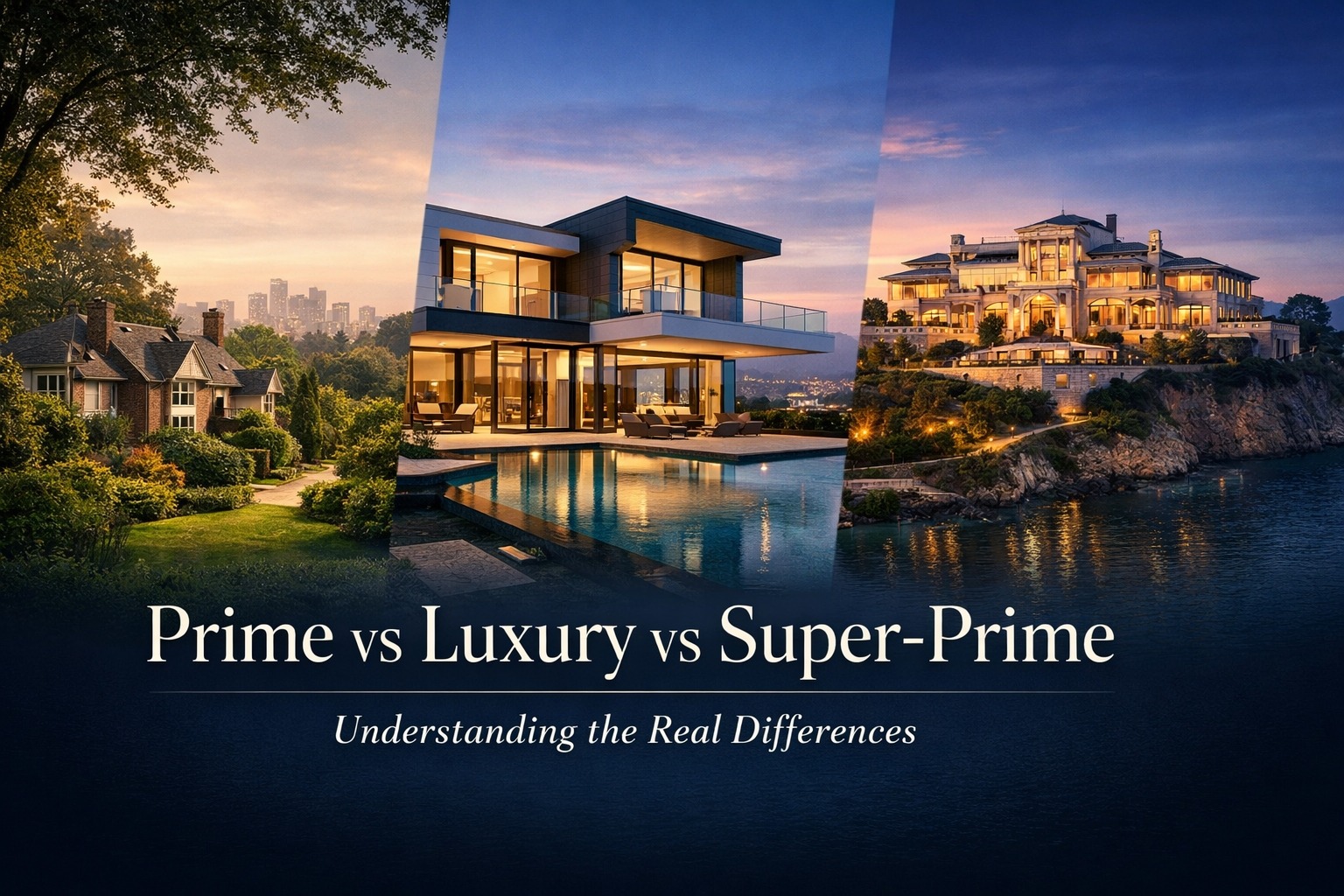
Prime vs Luxury Property: What Really Sets Them Apart
In real estate marketing, few words are used as loosely—and as confidently—as prime, luxury, and super-prime. A listing brochure may call a property “luxury” simply because it has a swimming pool. An agent may describe a neighbourhood as “prime” merely because demand is high. A developer may label a penthouse “super-prime” purely because of its price point.
But in professional property markets, these terms are not interchangeable. They signal specific differences in location quality, buyer profile, design standards, pricing logic, and long-term value behaviour. Understanding those differences is essential whether you are a homebuyer, investor, developer, lender, or simply a property enthusiast trying to make sense of the high-end market.
This guide demystifies the real distinctions between prime, luxury, and super-prime property—cutting through marketing language to explain what truly separates one tier from another, how values behave in each segment, and why some properties quietly outperform others over decades.
—
The Property Pyramid: How the Market Is Structurally Divided
Property markets are naturally tiered. At the base lies mass housing. Above it are aspirational homes. At the very top sit assets that are scarce, defensible, and often generational.
Think of the high-end market as a three-level pyramid:
– Prime property sits at the foundation of prestige
– Luxury property occupies the middle tier of lifestyle excellence
– Super-prime property forms the apex—rare, irreplaceable, and globally comparable
Each tier serves a different buyer mindset and performs differently during economic cycles.
—
What Is Prime Property?
Definition: Location-Led Value
Prime property is best defined by location quality, not opulence. A prime property sits in a highly desirable, well-established, and consistently in-demand location—even if the building itself is modest or dated.
In many cases, the land value far outweighs the structure sitting on it. In professional valuation, prime refers to where the property is, not necessarily what it looks like.
Prime areas are usually characterised by:
– Long-term planning controls
– Low density or controlled redevelopment
– Strong neighbourhood identity
– Proximity to economic, diplomatic, educational, or cultural hubs
Characteristics of Prime Property
– Superior location fundamentals
– Established infrastructure and access
– Stable, long-term demand
– Strong resale and rental liquidity
– Often suitable for redevelopment or upgrading
A 30-year-old house in a blue-chip neighbourhood may still be prime, even without modern finishes.
Who Buys Prime Property?
Prime buyers are typically:
– Long-term homeowners
– Developers seeking land security
– Investors prioritising capital preservation
– Buyers entering elite neighbourhoods with future upgrade plans
The buyer motivation is security of location, not immediate lifestyle indulgence.
How Prime Property Performs
Prime property tends to:
– Hold value during downturns
– Appreciate steadily rather than explosively
– Recover faster after market corrections
– Benefit disproportionately from infrastructure and zoning stability
In many markets, prime land outperforms luxury buildings over long time horizons.
—
What Is Luxury Property?
Definition: Lifestyle-Driven Real Estate
Luxury property is defined by quality of living, not just location. A luxury property offers exceptional comfort, design, finishes, and amenities that go beyond standard housing.
While location remains important, luxury focuses on how the property lives on a day-to-day basis. Luxury is experiential.
Core Features of Luxury Property
Luxury homes typically include:
– High-end architectural design
– Premium materials and finishes
– Thoughtful layouts and spatial flow
– Private amenities (pools, gardens, gyms, lifts)
– Advanced security and home automation
Luxury can exist in both prime and non-prime locations, though true luxury usually clusters in strong neighbourhoods.
The Buyer Psychology
Luxury buyers are motivated by:
– Lifestyle enhancement
– Comfort and aesthetics
– Status and self-expression
– Immediate usability without upgrades
These buyers expect turn-key excellence.
Market Behaviour of Luxury Property
Luxury property:
– Is more sensitive to economic cycles than prime land
– Can depreciate if design trends age poorly
– Performs best in growing economies
– Requires continuous maintenance to protect value
Luxury homes compete heavily with newer stock. Unlike prime land, they can be outdated by design evolution.
—
What Is Super-Prime Property?
Definition: Scarcity at the Highest Level
Super-prime property represents the top 1–2% of the market, where price, quality, location, and scarcity intersect. Super-prime is not just “very expensive luxury.” It is a distinct asset class.
A super-prime property must satisfy all of the following:
– Exceptional and irreplaceable location
– Architectural or historical significance
– Extreme privacy and exclusivity
– Global buyer appeal
– Permanent scarcity
If it can be replicated, it is not super-prime.
Typical Attributes of Super-Prime Property
– Landmark positioning (waterfront, ridge, heritage core)
– Ultra-low density or standalone estates
– Bespoke architecture and craftsmanship
– Concierge-level services or estate management
– Strong diplomatic, institutional, or global relevance
Super-prime homes are often trophy assets rather than lifestyle purchases.
Who Buys Super-Prime Property?
Super-prime buyers include:
– Ultra-high-net-worth individuals
– Family offices
– Institutional or legacy investors
– Buyers seeking wealth preservation rather than yield
For these buyers, property is a store of value, similar to art or rare land.
How Super-Prime Property Performs
Super-prime property:
– Is the least volatile segment
– Often appreciates independently of local cycles
– Attracts capital during global uncertainty
– Trades infrequently but at significant premiums
In many markets, super-prime values are set by scarcity, not comparables.
—
The Key Differences at a Glance
| Aspect | Prime | Luxury | Super-Prime |
|——–|——-|——–|————-|
| Location | Excellent, established, defensible | Good to excellent, lifestyle-oriented | Irreplaceable, iconic, globally recognised |
| Product Focus | Land and position | Design, comfort, finishes | Exclusivity and rarity |
| Buyer Motivation | Security and long-term value | Lifestyle and status | Capital preservation and legacy |
| Value Drivers | Zoning, neighbourhood integrity, demand | Build quality, design relevance, amenities | Scarcity, prestige, global capital flows |
—
Common Misconceptions in the Market
“Expensive Means Super-Prime”
Price alone does not define super-prime. A high price in a weak or replicable location is still just expensive luxury.
“Luxury Automatically Means Prime”
A luxury home in an emerging or overdeveloped area is not prime, regardless of finishes.
“All Prime Properties Are Luxury”
Many prime properties are modest, outdated, or purely land plays.
—
Why These Distinctions Matter to Buyers
For Homebuyers
Understanding the tier helps align expectations:
– Prime offers long-term security
– Luxury delivers immediate lifestyle
– Super-prime offers unmatched exclusivity
For Investors
Each tier behaves differently:
– Prime favours patient capital
– Luxury requires active management
– Super-prime suits wealth preservation strategies
For Developers
Mislabeling a project can destroy credibility. True luxury and super-prime buyers are highly discerning.
—
Long-Term Value: Which Performs Best?
Over long periods:
– Prime land often delivers the most consistent appreciation
– Luxury homes perform well when maintained and well-located
– Super-prime assets preserve wealth and outperform during uncertainty
The strongest portfolios often include a blend of all three, depending on objectives.
—
Beyond Marketing Language
Prime, luxury, and super-prime are not marketing buzzwords—they are economic classifications rooted in how property behaves over time.
Understanding the real differences allows buyers to:
– Make smarter purchasing decisions
– Avoid overpaying for labels
– Align property choices with long-term goals
In sophisticated property markets, clarity is power. And in high-value real estate, knowing exactly what you are buying matters more than what it is called.




Join The Discussion