

 by
by 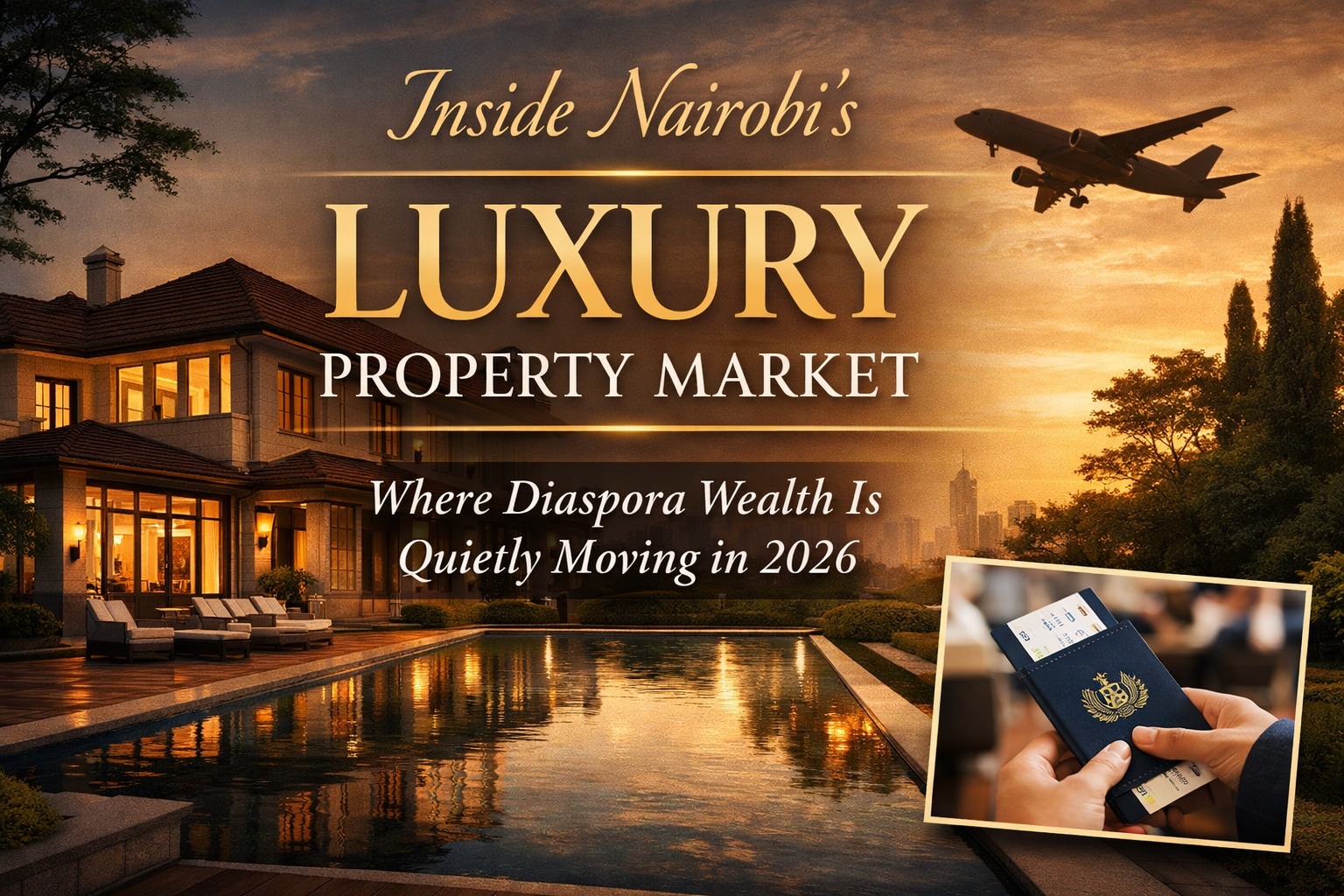
Nairobi Luxury Property Market: Diaspora Wealth Trends 2026
Nairobi’s luxury property market in 2026 is no longer driven by hype—it’s being quietly shaped by strategic diaspora luxury buyers nairobi investors who prioritize trust, scarcity, and long-term stability. Discover how prime enclaves like Karen, Muthaiga, and Runda are evolving around this smarter, more selective demand.
The era of rapid expansion headlines and broad speculative buying in Nairobi’s high-end real estate is over. In its place, a more refined, deliberate market has emerged—one powered by diaspora capital that is research-driven, patient, and long-term in outlook. For anyone tracking luxury property trends in Kenya, the shift is unmistakable: visibility and marketing no longer dominate buyer attention. Instead, trust, privacy, scarcity, and asset stability define the new rules of engagement.
This transformation is most visible in Nairobi’s prime residential zones—Karen, Muthaiga, Runda, Nyari, Kitisuru, and a handful of emerging low-density enclaves. To understand where the market is heading in 2026, you must first understand how luxury demand itself has evolved.
—
The Modern Diaspora Luxury Buyer: From Emotional Purchase to Strategic Asset Allocation
The diaspora buyer of 2026 is fundamentally different from the buyer of a decade ago. Previously, purchasing property in Kenya was often emotionally driven: I want a home back home, I want land for retirement, I want something my family can use.
While those motivations still exist, they are now layered with financial reasoning. Today’s diaspora luxury buyers nairobi behaves more like an asset allocator than a traditional homeowner. They evaluate property through questions such as:
– What is the long-term capital appreciation trend in this zone?
– Who is the developer, and what is their delivery history?
– How liquid is this asset class if I need to exit?
– What is the security profile of the neighbourhood?
– Can this property serve both lifestyle and investment purposes?
This evolution has raised the bar significantly for developers, agents, and the entire luxury ecosystem.
—
Why Nairobi’s Luxury Market Remains Structurally Attractive
Despite global economic uncertainty, Nairobi continues to attract high-end diaspora interest for three key structural reasons.
A. Relative Undervaluation in Global Terms
Compared to cities like London, Dubai, or Toronto, Nairobi’s prime homes still offer significantly lower entry prices for similar lifestyle quality in select gated environments.
B. Strong Diaspora Remittance Flow
Kenya consistently receives billions in annual diaspora remittances—a portion of which flows directly into real estate acquisition and construction.
C. Scarcity of True Prime Land
In areas like Karen and Muthaiga, land availability is structurally limited. This creates long-term value retention rather than speculative volatility.
Together, these three factors create a market that is not necessarily fast-moving, but resilient and supply-constrained.
—
Karen: The Balance Between Space, Privacy, and Family Living
Karen remains one of Nairobi’s most consistently sought-after luxury suburbs. What defines Karen is not density—it is the absence of it. Large plots, mature greenery, and low-rise residential zoning create an environment that prioritizes privacy over density.
Why diaspora buyers choose Karen:
– Ideal for multi-generational homes
– Strong appeal for retirement planning
– Proximity to international schools and hospitals
– Space for compound-style living (guest houses, gardens, home offices)
However, what is often overlooked is Karen’s internal segmentation. Not all parts of Karen carry the same value profile. Proximity to key roads, infrastructure upgrades, and gated micro-communities all influence pricing significantly. For diaspora luxury buyers nairobi, understanding these micro-distinctions is essential.
—
Muthaiga: Nairobi’s Most Discreet Wealth Enclave
Muthaiga is less a market and more a legacy zone. Unlike other suburbs that actively expand or brand themselves, Muthaiga’s value is anchored in history, exclusivity, and extreme privacy.
It is home to:
– Long-established Kenyan families
– Diplomatic residences
– Ultra-high-net-worth individuals
What defines Muthaiga’s value:
– Extremely limited turnover of properties
– Strong preservation of architectural integrity
– High barriers to entry
– Quiet ownership culture
For diaspora investors, Muthaiga is often not a first purchase—it is a final-stage acquisition, once wealth positioning is already established. Its liquidity is low, but its prestige and long-term stability remain unmatched.
—
Runda: Structured Luxury for Modern Diaspora Families
Runda represents a more modern expression of luxury living. Unlike Karen’s organic sprawl or Muthaiga’s legacy exclusivity, Runda is defined by structured estates and controlled development.
Key advantages of Runda:
– Gated community planning with controlled access
– Modern architectural homes (often newer builds)
– Strong suitability for family relocation
– Proximity to key diplomatic and international zones
Runda appeals strongly to diaspora families returning with children or planning frequent stays in Kenya. It offers a balance between comfort, security, and practicality—without sacrificing premium positioning.
—
Nyari & Kitisuru: The New Wave of Quiet Luxury
Nyari and Kitisuru have emerged as increasingly important nodes in Nairobi’s luxury ecosystem. They are not as historically established as Muthaiga, nor as expansive as Karen, but they offer something increasingly valued: modern discretion.
Their appeal includes:
– Contemporary villa designs with clean architecture
– Lower traffic and quieter environments
– Strong expatriate and diplomatic presence
– Proximity to key embassies and international schools
For diaspora buyers who prefer understated luxury rather than legacy-driven prestige, these areas provide a compelling alternative.
—
What Diaspora Buyers Are Really Evaluating (Beyond Listings)
One of the most important shifts in the market is that diaspora luxury buyers nairobi are no longer reacting to listings—they are evaluating systems. At the luxury level, the decision process now includes:
1. Developer credibility — Track record, delivery timelines, and past project completion quality matter significantly.
2. Legal clarity — Title verification, zoning compliance, and land ownership structure are critical due diligence steps.
3. Security infrastructure — Not just gated access, but response systems, surveillance integration, and neighbourhood coordination.
4. Exit strategy — Buyers increasingly consider resale demand, rental viability, and long-term liquidity even before purchase.
5. Management capability — For those not residing full-time in Kenya, property management and maintenance systems are part of the investment decision.
This marks a significant maturation of the diaspora investor base.
—
The Rise of Off-Market and Relationship-Based Transactions
Unlike mid-market real estate, luxury transactions in Nairobi are increasingly moving away from public listings. A growing share of deals are:
– Privately negotiated
– Introduced through trusted intermediaries
– Structured via referral networks
– Executed with confidentiality clauses
This is particularly relevant in Muthaiga, Karen, and parts of Runda, where discretion is part of the value proposition. For diaspora buyers, this means that access is becoming as important as affordability.
—
Market Direction: Stability Over Speculation
Contrary to expectations of rapid price spikes, Nairobi’s luxury real estate market is currently experiencing a phase of controlled stability.
Key trends include:
– Gradual appreciation in prime zones
– Limited speculative flipping at the top end
– Increased buyer scrutiny
– Stronger emphasis on build quality over volume
This is not a market driven by hype cycles. It is a market driven by capital preservation and selective demand.
—
Long-Term Outlook: Why Prime Nairobi Property Remains Resilient
Looking ahead, the outlook for Nairobi’s luxury residential segment remains structurally stable for three reasons:
1. Land scarcity in prime zones — Expansion is limited by geography and zoning restrictions.
2. Growing diaspora wealth base — Increasing numbers of Kenyans abroad are entering high-income brackets.
3. Lifestyle repatriation trend — More diaspora families are planning partial or full return over time.
These factors create a consistent baseline demand for high-end properties, even in slower macroeconomic cycles.
—
Luxury Real Estate in Nairobi Is Becoming a Trust-Based Market
The defining characteristic of Nairobi’s luxury property market in 2026 is not visibility—it is selectivity.
– Karen offers space and lifestyle continuity.
– Muthaiga offers legacy and extreme exclusivity.
– Runda offers structured modern family living.
– Nyari and Kitisuru offer understated contemporary luxury.
But across all these zones, one truth remains consistent: diaspora luxury buyers nairobi are no longer just purchasing property in the city. They are evaluating trust, systems, and long-term value preservation before they ever commit capital.
And in that sense, Nairobi’s luxury market is no longer simply a real estate story. It is a confidence story—written slowly, carefully, and quietly.


Join The Discussion